Cut your household bills

Six ways to trim the bills that hit every month — energy, council tax, broadband, insurance and more — plus the support many people don't realise they can claim.

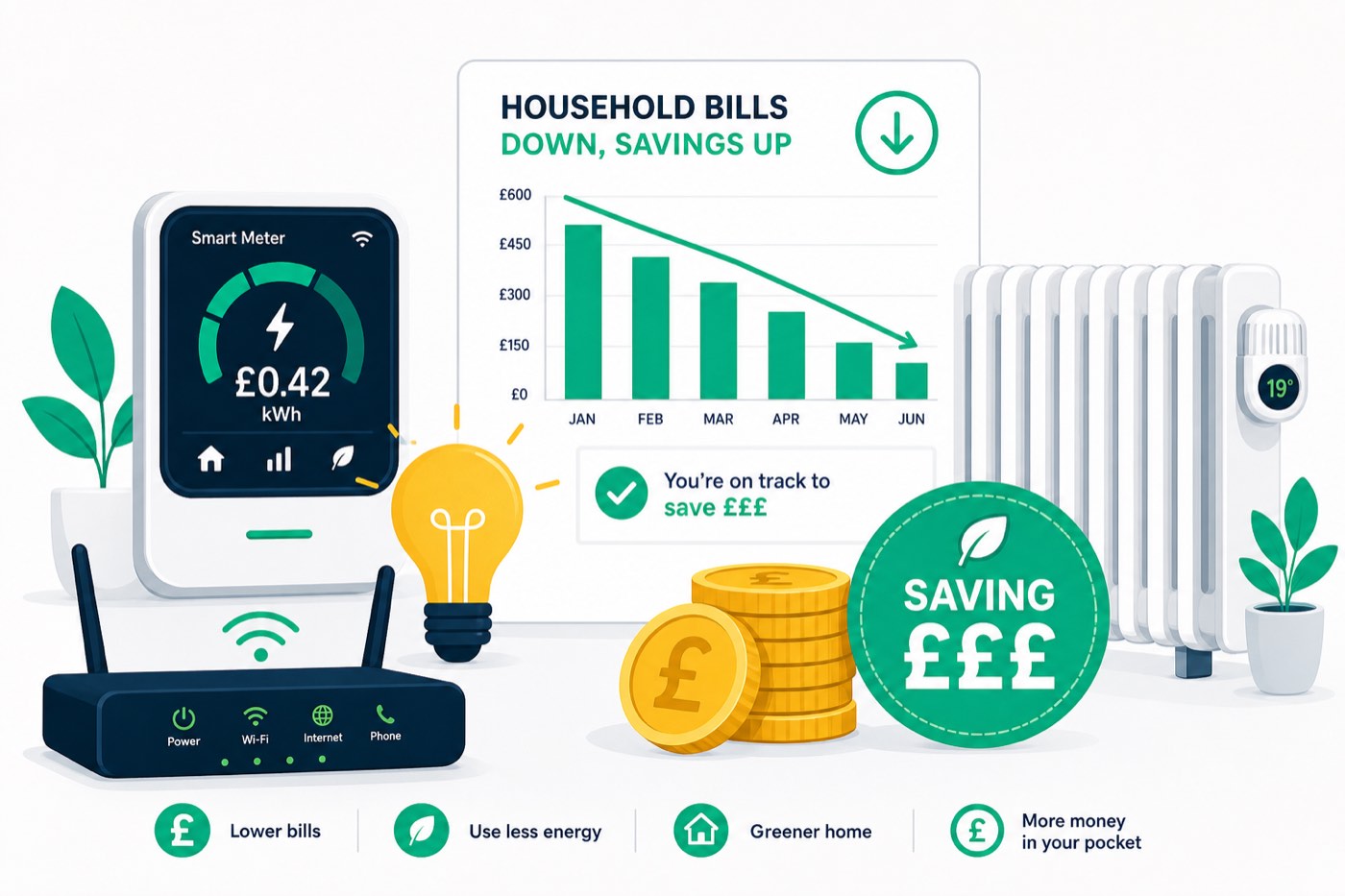
Smart energy meter, broadband router, radiator and a falling household bills chart with pound coins saved

Household bills are where "set and forget" quietly costs you the most. A couple of focused hours reviewing energy, council tax, broadband and insurance can save a typical household hundreds of pounds a year — money that stays in your pocket every month afterwards.

1

Get your energy bills under control

The Ofgem price cap limits unit rates and standing charges on standard variable tariffs and changes each quarter — but it caps rates, not your total bill, so using less always helps. To save:

  • Submit regular meter readings (or use a smart meter) so bills are accurate, not estimated.
  • Compare fixed deals — at times a fix can beat the cap and adds certainty.
  • If you're vulnerable or of pension age, join your supplier's free Priority Services Register.
2

Check your council tax band and discounts

Council tax is a big annual cost and easy to overpay:

  • Wrong band? Many homes were banded quickly in 1991 and some are too high. You can check neighbouring properties' bands and challenge yours if it looks wrong.
  • Live alone? Claim the 25% single-person discount.
  • Discounts & exemptions exist for full-time students, carers, and people with a severe mental impairment.
  • On a low income? Apply for Council Tax Reduction through your local council.
3

Haggle (or switch) broadband and mobile

Out-of-contract customers usually pay the most. When your deal ends, get a quote from a rival, then call your provider's retentions team and ask them to match or beat it — mention you're ready to leave. For mobiles, a SIM-only deal is far cheaper than a phone contract if your handset still works. On a low income or certain benefits, ask about social tariffs, which offer cheaper broadband and mobile.

Advertisement
4

Never auto-renew your insurance

Car, home, pet and travel insurers often quietly raise renewal prices. Instead:

  • Compare quotes about 3–4 weeks before renewal — often the cheapest moment.
  • Use the best quote to haggle with your current insurer.
  • Pay annually if you can — monthly instalments usually add interest.
  • Check whether combining policies (e.g. multi-car) is cheaper.
5

Could a water meter save you money?

If your home has more bedrooms than people, a water meter often works out cheaper because you pay for what you use rather than a fixed charge based on your property. Many suppliers let you try a meter and switch back within a set period if it doesn't save. Low-income households with high essential water use may qualify for schemes like WaterSure.

6

Claim the support you're entitled to

Billions in support goes unclaimed each year. It's worth a check:

  • Use a free benefits calculator (e.g. via Turn2us or MoneyHelper) — many working households are eligible for more than they think.
  • Ask your council about the Household Support Fund.
  • Check the Warm Home Discount on energy and, for older people, Pension Credit, which unlocks other help.

Quick recap

  • Submit meter readings and compare fixed energy deals
  • Check your council tax band and claim discounts
  • Haggle or switch broadband and mobile
  • Shop around before every insurance renewal
  • Use a benefits calculator to claim what you're due

Frequently asked questions

Are price comparison sites trustworthy?

They're a useful starting point, but no single site covers the whole market, and some deals are only available direct. Check two or three, and always read what's actually included (excess, add-ons, contract length) rather than sorting on headline price alone.

Is it worth challenging my council tax band?

It can be, but check carefully first — a successful challenge could also raise a neighbour's band, and in rare cases yours. Compare similar nearby properties before you apply.

How do I know if I qualify for a social tariff?

Social tariffs for broadband and mobile are generally for people receiving certain benefits such as Universal Credit. Check your provider's website or Ofcom's list of available social tariffs.