How to budget (and actually stick to it)

Seven simple budgeting tips to take control of your money — no spreadsheets-from-hell required.

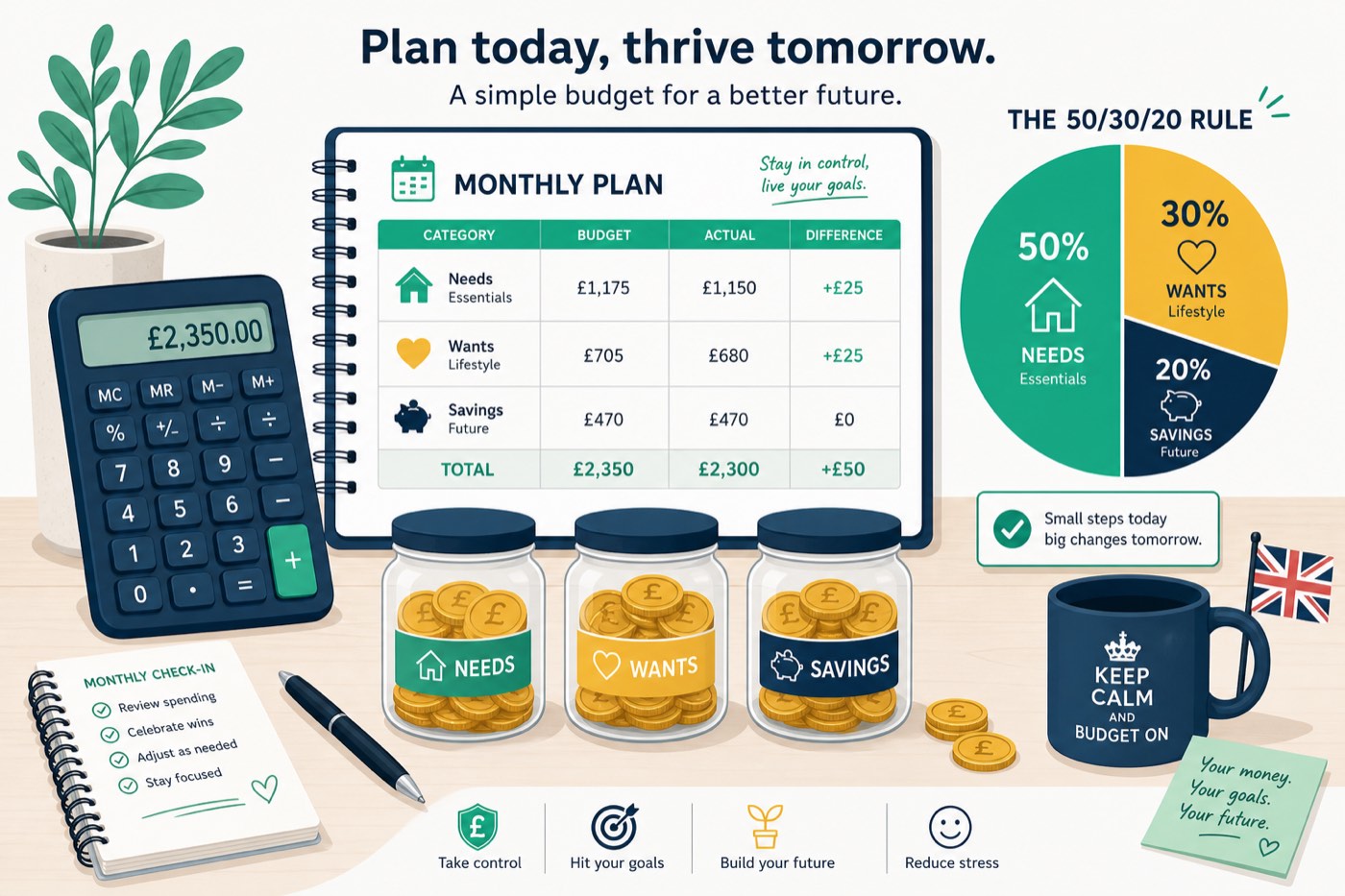
Calculator, monthly budget planner, coin jars split into needs, wants and savings, and a 50/30/20 pie chart

A budget isn't about restriction — it's about knowing where your money goes so it goes where you want. Get this foundation right and every other money goal, from clearing debt to investing, becomes far easier.

1

Start with the 50/30/20 rule

If you don't know where to begin, split your take-home pay three ways:

  • 50% needs — rent/mortgage, bills, food, transport, minimum debt payments
  • 30% wants — eating out, subscriptions, hobbies, treats
  • 20% savings & debt — emergency fund, overpaying debt, pensions, investing

It's a starting point, not a straitjacket. If your rent is high, your "needs" slice will be bigger — the point is to give every pound a job.

2

Track every penny for one month

You can't manage what you don't measure. For one month, record everything you spend — banking apps make this easy by categorising transactions automatically. Most people find at least one "where did that go?" moment. That awareness alone tends to cut spending, no willpower needed.

3

Pay yourself first

Don't save whatever's left at the end of the month — there's rarely anything left. Instead, set up a standing order the day after payday to move money straight into savings. Treat it like any other bill. Automating good decisions beats relying on discipline every single time.

Advertisement
4

Plan for irregular bills with sinking funds

Christmas, car MOT, insurance renewals, birthdays — these aren't emergencies, they're predictable. A sinking fund means setting aside a little each month so the bill is already covered when it lands. For example, £240 a year for Christmas is just £20 a month. It's the single best way to stop annual costs from tipping you into your overdraft.

5

Cut the big three, then the small stuff

The biggest savings usually come from your largest costs: housing, transport and food. Cutting your grocery bill with a weekly meal plan, a shopping list and swapping to own-brand ("the downshift challenge") can save a family hundreds a year. Only once the big rocks are handled is it worth sweating the small stuff.

6

Kill "zombie" subscriptions

Streaming services, apps, gym memberships and free trials that quietly became paid — the average household leaks money on things it no longer uses. Scan your statement for recurring payments and cancel anything you'd not miss. Then haggle the ones you keep: broadband, mobile and TV providers often improve your deal if you ask (or threaten to leave).

7

Beat impulse spending

Two tricks that work: use the 24-hour rule for non-essential buys (sleep on it — most urges pass), and stack up cashback and loyalty where you'd spend anyway using cashback sites, supermarket schemes and bank rewards. Just never buy something you don't need to "earn" cashback.

Quick recap

  • Split your pay with the 50/30/20 rule
  • Track spending for a month to find leaks
  • Automate savings the day after payday
  • Use sinking funds for predictable bills
  • Cancel unused subscriptions and haggle the rest

Frequently asked questions

Which budgeting app should I use?

The best tool is the one you'll keep using. Many people are happy with their bank's built-in spending breakdown; others prefer a dedicated budgeting app or a simple spreadsheet. Try one for a month before committing.

I have debt — should I still save?

Build a small emergency buffer (say £500–£1,000) first so a surprise cost doesn't send you back to borrowing, then focus on clearing expensive debt. See our debt & credit guide.

What if my income is irregular?

Budget on your lowest likely month and treat anything above that as a bonus to save or clear debt. A larger emergency fund (closer to six months) is wise for variable or self-employed incomes.