Pound-cost averaging explained
Invest a fixed amount on a schedule so you buy more units when prices are low and fewer when they are high — without pretending you can time the market.
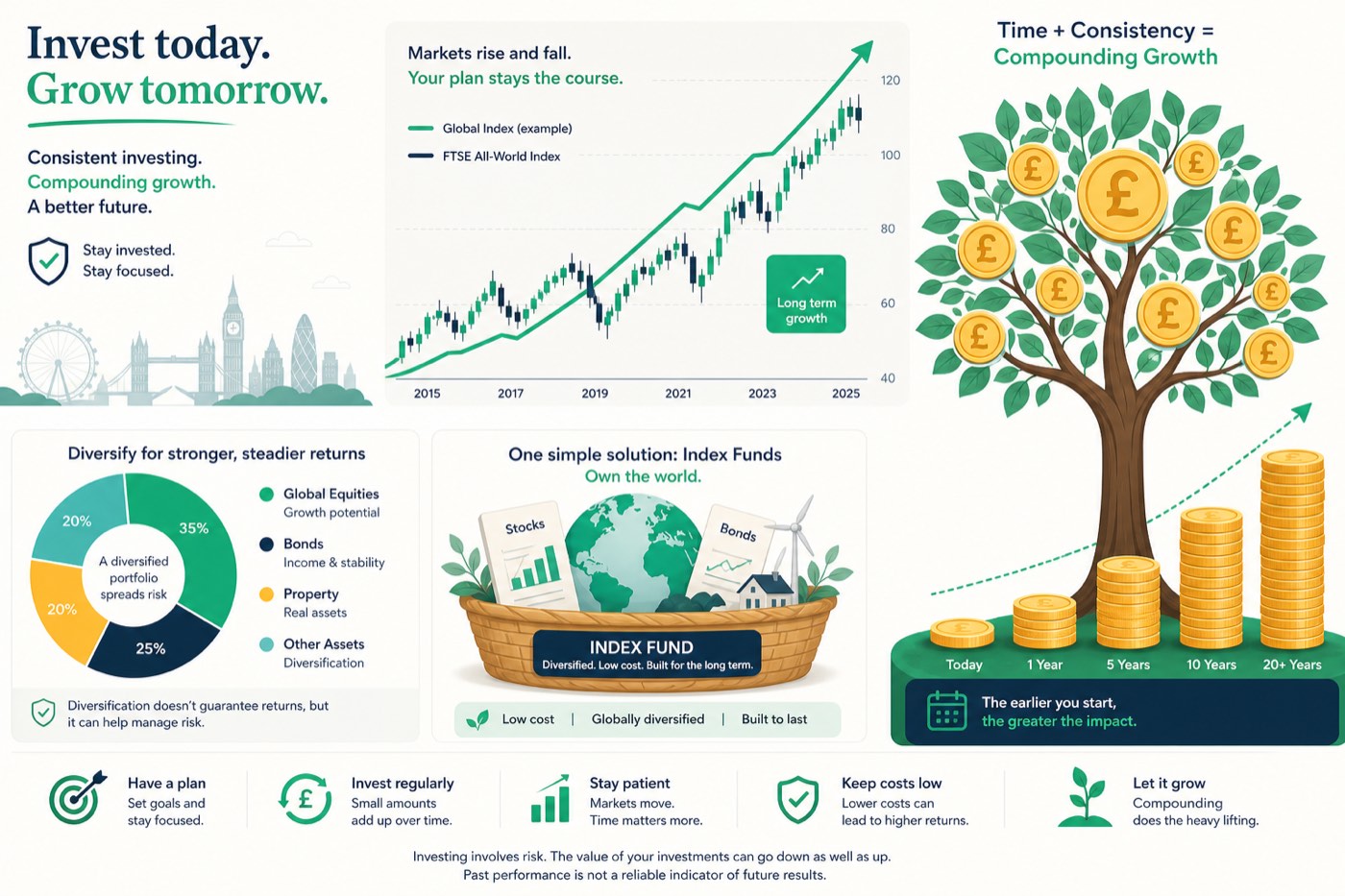
Pound-cost averaging means investing a set sum at regular intervals — for example £150 every month into a diversified fund inside a Stocks & Shares ISA — regardless of whether markets feel euphoric or grim. It is a behaviour tool more than a magic formula. It does not guarantee profit, and a lump sum invested earlier can outperform in steadily rising markets. You can still lose money. This is general information for UK readers, not personal advice.
Who this guide is for
Long-term UK investors comparing regular monthly investing with investing an available lump sum. It is most relevant after emergency savings and expensive debt are addressed.
Not for: Anyone believing monthly investing guarantees a profit or removes market risk; it changes timing exposure, not the underlying investment.
Why regular investing helps real humans
Most people earn monthly and feel emotional about headlines. A standing order removes the decision "is today the day?" You automatically buy more units when prices dip and fewer when they rally, which can smooth the average purchase price over time.
It also builds the habit of investing continuously through boring months — usually when wealth is quietly built.
Think of it as removing unnecessary decisions. You still choose the fund and the amount, but you stop debating every headline. That boredom is a feature. Markets will still swing; your calendar invite will not.
What pound-cost averaging does not do
It does not eliminate risk. If your fund halves and never recovers in your timeframe, averaging in still loses. It does not beat every lump-sum strategy on paper. If you already hold a large cash sum destined for long-term equities, academic illustrations often favour investing sooner rather than dripping endlessly — but real life includes regret risk and sleep-at-night factors.
Never use money needed for rent, debt payments or near-term goals.
Pound-cost averaging also does not protect you from holding a poor or fraudulent product. Automating contributions into something you do not understand — or into a tip from social media — simply loses money more neatly. Verify firms on the FCA Register and prefer diversified, transparent funds if you are a beginner.
Practical setup in a UK ISA or pension
Pick a diversified fund you understand, confirm fees, then automate contributions on payday. Review once or twice a year, not every evening. Use the £20,000 ISA allowance (2026/27) if a Stocks & Shares ISA fits your plan, or increase workplace pension contributions if that is more appropriate — we are not choosing for you.
- Align the payment date with salary
- Keep an emergency fund outside volatile investments
- Write rules for pausing contributions only in genuine hardship
If you receive an annual bonus, some people invest a portion as a separate lump sum while keeping the monthly standing order. Others drip the bonus over several months to reduce regret if markets fall the next week. Neither approach is "correct" in the abstract; both still require a long horizon and acceptance of loss.
Behaviour beats prediction
The biggest failure mode is stopping contributions after a fall — locking in the pain and missing recovery months. The second is doubling down on speculative tips because averaging "feels safe". Stay sceptical of anyone promising guaranteed returns from a "system". Check firms via the FCA and read MoneyHelper.
Pair averaging with a written goal: "This ISA money is for retirement income after 2045," for example. Goals stop you raiding the pot for a sofa the first time markets wobble. If your goal date is only two years away, rethink whether equities belong there at all.
Timing risk versus time in market
Pound-cost averaging means investing fixed sterling amounts at intervals. When the unit price is lower, the fixed amount buys more units; when higher, fewer. This can automate behaviour and reduce regret around one entry date. It does not ensure a lower average price, and delaying an already-available lump sum leaves part in cash while markets may rise.
| Month | Unit price | £200 buys |
|---|---|---|
| 1 | £10 | 20.00 units |
| 2 | £8 | 25.00 units |
| 3 | £12 | 16.67 units |
| Total | £600 invested | 61.67 units |
The average purchase price is about £9.73 (£600 ÷ 61.67), not the simple average of prices. At £12 the holding is worth roughly £740. This favourable path was chosen for illustration; if prices rise £8, £10, £12, investing £600 at the start at £8 would have bought 75 units and finished ahead.
Second example: Marcus receives £24,000 and wants equities for a 15-year goal. He can tolerate risk but fears immediate loss. Rather than leave the decision open-ended, he invests £12,000 now and £2,000 monthly for six months, keeping emergency cash separate. This behavioural compromise may underperform immediate investment in a rising market, but it has a written end date and avoids indefinitely waiting for a “better” price.
- Ask whether the money arrives monthly or already exists as a lump sum.
- Set horizon, asset allocation and risk capacity first; timing cannot rescue unsuitable investments.
- Compare platform dealing fees—£5 on every £100 purchase is a 5% drag.
- Automate after payday and retain enough cash for short-term needs.
- If phasing a lump sum, set dates and amounts in advance.
- Continue through ordinary volatility unless goals, horizon or capacity change—not merely because prices fell.
Regular investing works particularly naturally for salary-funded pension and ISA contributions. Stay within the £20,000 ISA allowance for 2026/27 across ISA types. Reinvested distributions and charges affect units, so platform statements may not match a simple spreadsheet.
Markets can remain below your purchase price for many years and averaging into a falling, concentrated asset can compound losses. Keep contribution records so returns are measured against actual cash flows, not memory. Diversification and suitability matter more than the schedule. This is general information, not a recommendation to invest immediately or gradually.
Worked UK example: three monthly purchases
Lee invests £200 on the same day each month into a global index fund. Month 1 unit price £2.00 → 100 units. Month 2 price £1.60 → 125 units. Month 3 price £2.00 → 100 units. Lee has invested £600 and holds 325 units at an average cost of about £1.85. A friend who waited for a "perfect dip" bought nothing for two months and then hesitated again. Lee's process is the point — not a promise that £1.85 will look clever next year. Prices can keep falling. Illustrative units only.
Step-by-step checklist
- Confirm the money is truly long-term
- Choose a diversified investment you can explain simply
- Automate a realistic monthly amount on payday
- Account for platform and fund fees
- Use ISA or pension wrappers where appropriate (£20,000 ISA limit for 2026/27)
- Schedule a calm annual review, not daily checking
- Decide in advance not to panic-stop after a market drop
Common mistakes
- Believing averaging guarantees a profit
- Averaging into a single speculative share tip
- Stopping buy orders exactly when prices are low
- Investing rent money on a rigid schedule
When to get regulated help
See MoneyHelper for investing basics and FCA resources for warnings. Tax wrapper details: GOV.UK. No personal recommendation is made here.
Frequently asked questions
Is pound-cost averaging better than a lump sum?
Not always. Lump sums can do better in rising markets; averaging can help with discipline and regret. Suitability depends on your situation.
How often should I invest?
Monthly matches most UK pay cycles and is easy to automate. The best schedule is one you will keep.
Should I pause when markets fall?
Falls are usually when regular buying purchases more units. Pausing for fear can undermine the method — though genuine hardship is different.
Can I pound-cost average inside an ISA?
Yes. Many people set monthly buys inside a Stocks & Shares ISA, staying within the annual allowance.