Check your tax code before it costs you
A wrong PAYE code is one of the most common reasons people overpay or underpay Income Tax during the year.
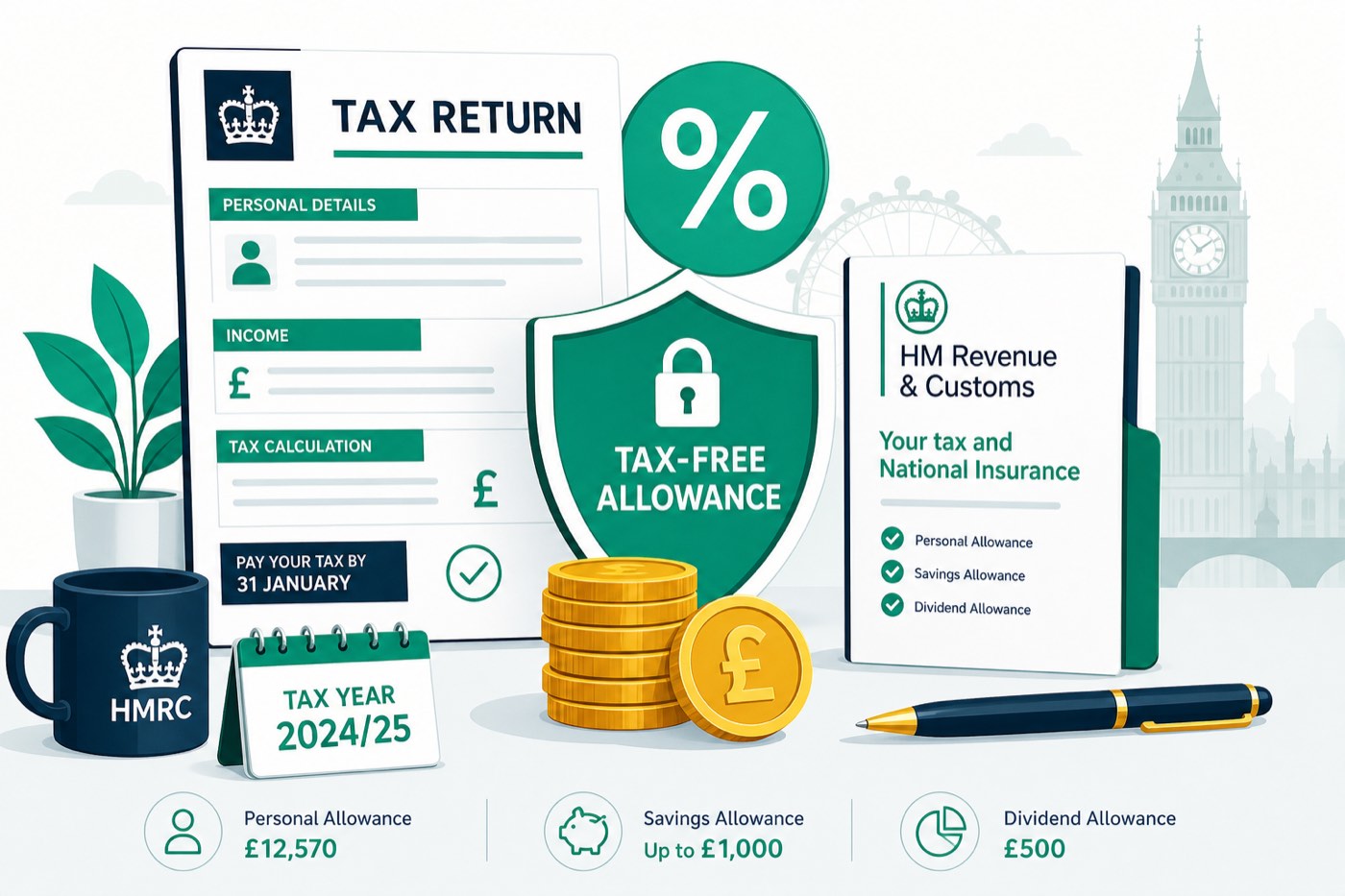
Your tax code tells your employer how much Income Tax to deduct. The standard code for someone with a full £12,570 Personal Allowance is often 1257L, but benefits, second jobs, underpayments and Marriage Allowance can change the numbers and letters. Checking it takes minutes and can reclaim hundreds of pounds.
Who this guide is for
PAYE employees and pension recipients who want to decode a tax code or investigate an unexpected payslip change. Checking is particularly worthwhile after changing jobs or receiving benefits.
Not for: Self-employed people looking for their final annual liability; a PAYE code does not replace Self Assessment.
Where to find your code
Look at your payslip, your personal tax account on GOV.UK, or HMRC notices. Each employer and pension payer may use a code. Two jobs often mean one main code with allowance and a second code like BR (basic rate on all income from that job) — that can be correct, but it needs a sanity check.
Common codes and what they hint at
1257L — usually full Personal Allowance. Emergency codes (often with W1/M1) — temporary; tax may be collected on a non-cumulative basis and need sorting. BR, D0, D1 — tax all income from that source at basic, higher or additional rates. K codes — deductions exceed allowances (for example large benefits).
Letters still matter: L is common; M or N can relate to Marriage Allowance; S or C can indicate Scottish or Welsh rates.
How codes go wrong
Starting a job without a P45, overlapping employments, company cars, changing benefits mid-year, or HMRC estimating side income can all skew the code. Sometimes you overpay for months then receive a refund after a reconciliation; sometimes you get a surprise bill.
If your code embeds an underpayment, HMRC is collecting old tax via PAYE. That may be intentional — still confirm the amount is right.
How to fix it
Update your personal tax account, send an income update, or contact HMRC with evidence (P45, benefit letters). Employers cannot invent a kinder code; they must follow HMRC. Keep payslips until the tax year is reconciled.
After a fix, watch the next two payslips. Year-to-date tax should start making sense against the £12,570 allowance and your band.
Decode the code, then verify it
A tax code tells payroll how much tax-free pay, adjustment or special treatment to use; it is not confirmation that the final tax is correct. The common code 1257L broadly reflects the £12,570 Personal Allowance. HMRC removes the final digit and payroll spreads the coded allowance across pay periods. Letters can indicate circumstances: BR generally taxes all pay from that source at basic rate, D0 at higher rate, and NT means no tax deducted.
| Code feature | Possible meaning | Check first |
|---|---|---|
| 1257L | Standard allowance in many cases | Estimated income and other deductions |
| W1 / M1 / X | Non-cumulative emergency basis | Starter details and prior P45 |
| BR | All pay at basic rate | Whether this is genuinely a second income |
| K prefix | Adjustments exceed allowances | Benefits or tax owed shown by HMRC |
Worked example: Ravi leaves Job A in June and starts Job B without a P45. Job B initially uses 1257L M1, giving one month's allowance without reconciling earlier pay. After HMRC receives both records, it issues a cumulative code. Ravi compares the “taxable pay to date” and “tax paid to date” fields, not only this month's deduction. If Job A remains incorrectly marked active, HMRC may divide allowances between employments and Job B can over-deduct.
- Compare the code on the payslip with HMRC's online record and coding notice.
- Check employer names, start/end dates and projected annual income.
- Open each adjustment: company car, medical cover, earlier underpayment or untaxed income.
- Tell HMRC which figures are wrong; payroll normally cannot choose a different code without HMRC instruction.
- Keep the revised notice and check the next two payslips for implementation and any refund.
A second example: Helen's code includes £1,200 of private medical benefit although she left the scheme in April. Roughly £1,200 less coded allowance could collect around £240 extra over a year for a basic-rate taxpayer. She asks her employer to confirm the benefit end date and updates HMRC. The exact correction depends on payroll reporting and her total position.
Do not assume a K code is a penalty or that an emergency code always overtaxes; either can be correct. Nor should you post a full payslip online—it contains identifiers useful to fraudsters. HMRC can often reconcile overpaid PAYE automatically, but submit requested information promptly and check refund messages through official channels to avoid phishing.
Use your Personal Tax Account or official HMRC contact details. This is general information, not individual tax advice.
Worked example: emergency code cost
Sam starts a £32,000 job in May without a P45 and is put on an emergency code. For three months Sam pays noticeably more tax than a colleague on 1257L. After HMRC issues the correct cumulative code, later payslips reduce deductions and Sam’s personal tax account shows a refund due of several hundred pounds. Checking the code in week one would have avoided the cash-flow hit.
Step-by-step checklist
- Read the tax code on your latest payslip
- Compare it with your HMRC personal tax account
- List all jobs, pensions and taxable benefits
- Note whether a second job uses BR or similar
- Act quickly on emergency codes after a job change
- Keep P45/P60 records for at least the current and prior year
- Re-check after Marriage Allowance or benefit changes
Common mistakes
- Assuming the employer “sorted tax” without looking at the code
- Ignoring a W1/M1 emergency basis for months
- Forgetting a second small job still needs a correct code
- Throwing away P60s before checking a possible refund
When to get regulated help
Use your personal tax account on GOV.UK to view and update codes. For independent explanations of payslip terms, visit MoneyHelper.
Frequently asked questions
What does 1257L mean?
It usually means you receive the standard £12,570 Personal Allowance, with L indicating the basic personal allowance situation.
Can I ask payroll to change my code?
Payroll must use the code HMRC supplies. You fix issues with HMRC, then payroll follows the update.
Why is my refund not instant?
HMRC may adjust via PAYE over remaining months or pay a refund after processing — timing varies.
Do pensioners have tax codes too?
Yes — pension payers use tax codes, and multiple pensions can create the same second-income issues as second jobs.
Can my employer change a wrong tax code?
Payroll generally applies the code supplied by HMRC. Correct the underlying information with HMRC; the employer can fix payroll data such as an incorrect start date.